


Six Oracle vendors on the panel. Three different rate structures. An SLA tracker that changes color more often than a traffic light. If that sounds familiar, you’re not alone. Subcontractor rates in the US keep climbing while 76% of IT employers globally report difficulty finding skilled talent, according to ManpowerGroup’s 2025 workforce report. Oracle roles are especially hard to fill because the work demands a specific mix of database architecture, PL/SQL, ERP modules, and cloud infrastructure that narrows the talent pool fast.
At the same time, the pressure to consolidate vendors keeps building. Fewer partners, better quality, tighter cost control. The question is where to find Oracle professionals who can deliver without blowing the budget or adding more suppliers to an already crowded panel.
This article walks through how US companies are answering that question with nearshore Oracle teams in Latin America, and what procurement leaders should know before making the move.
Oracle projects don’t fail because of bad technology. They stall because the right people aren’t in place when the work starts. And for procurement managers responsible for sourcing that talent, the current market makes the job harder than it should be.
Start with availability. The US has more than 1.2 million unfilled tech positions as of early 2026, according to Bureau of Labor Statistics data analyzed by altLINE. Oracle-specific roles are a subset of that number, but they’re among the hardest to fill. An Oracle DBA or APEX developer needs deep experience with database architecture, performance tuning, enterprise integrations, and often specific ERP modules like Financials or SCM. Most general software developers can’t step into these roles. The pool of qualified candidates is small, and everyone is fishing in it.
Then there’s cost. Senior Oracle professionals in the US bill between $75 and $150 per hour for contract work, depending on specialization and metro area. Those rates have been trending upward steadily, and US IT salaries overall have climbed more than 20% over the past three years, according to IT Convergence’s analysis of industry compensation trends. For procurement teams already under pressure to control spend, those numbers make it difficult to staff a multi-consultant Oracle initiative without exceeding budget.
And then there’s the vendor problem. Many companies have accumulated five, eight, even ten or more IT staffing suppliers over the years, each with their own rate structures, submission processes, and SLA definitions. Keeping track of which vendor is performing, which one is overcharging, and which one hasn’t submitted a qualified candidate in months turns into a full-time job. That’s before you factor in the compliance and audit overhead of managing contracts across that many relationships.
There’s a misconception that “nearshore” means a group of offshore developers who happen to be a few time zones closer. That’s not how it works when it’s done well.
A nearshore Oracle team is typically composed of professionals based in Mexico, Colombia, Brazil, or other LATAM countries who are specifically vetted for Oracle projects. The roles mirror what you’d staff onshore:
These consultants join your existing Agile ceremonies, use your tools, attend your daily stand-ups. Because most LATAM countries sit within 1–3 hours of US time zones, they overlap with your team for six to eight working hours per day. That’s enough for real-time collaboration on sprint planning, code reviews, issue triage, and stakeholder meetings. It’s a different experience from waiting 12 hours for an offshore team to respond to a question you asked at 9 AM.
The operational side matters too, especially for procurement. A structured nearshore staffing partner handles all local employment, payroll, tax obligations, and labor law compliance in each country. Your team doesn’t take on additional HR or legal burden. The consultants show up as part of your project team; the staffing partner manages everything behind the scenes.
Schedule a call and get a transparent rate comparison:
Let’s skip the narrative and look at what this model produces in terms procurement teams can evaluate directly.
Nearshore Oracle consultants bill at $35–$70 per hour versus $75–$150 onshore, with shortlists delivered in 24–72 hours instead of the 4–12 weeks a US search typically takes. When you factor in 6–8 hours of daily time-zone overlap and a partner that handles all LATAM payroll and compliance, the total cost of engagement drops well beyond what the rate difference alone suggests.
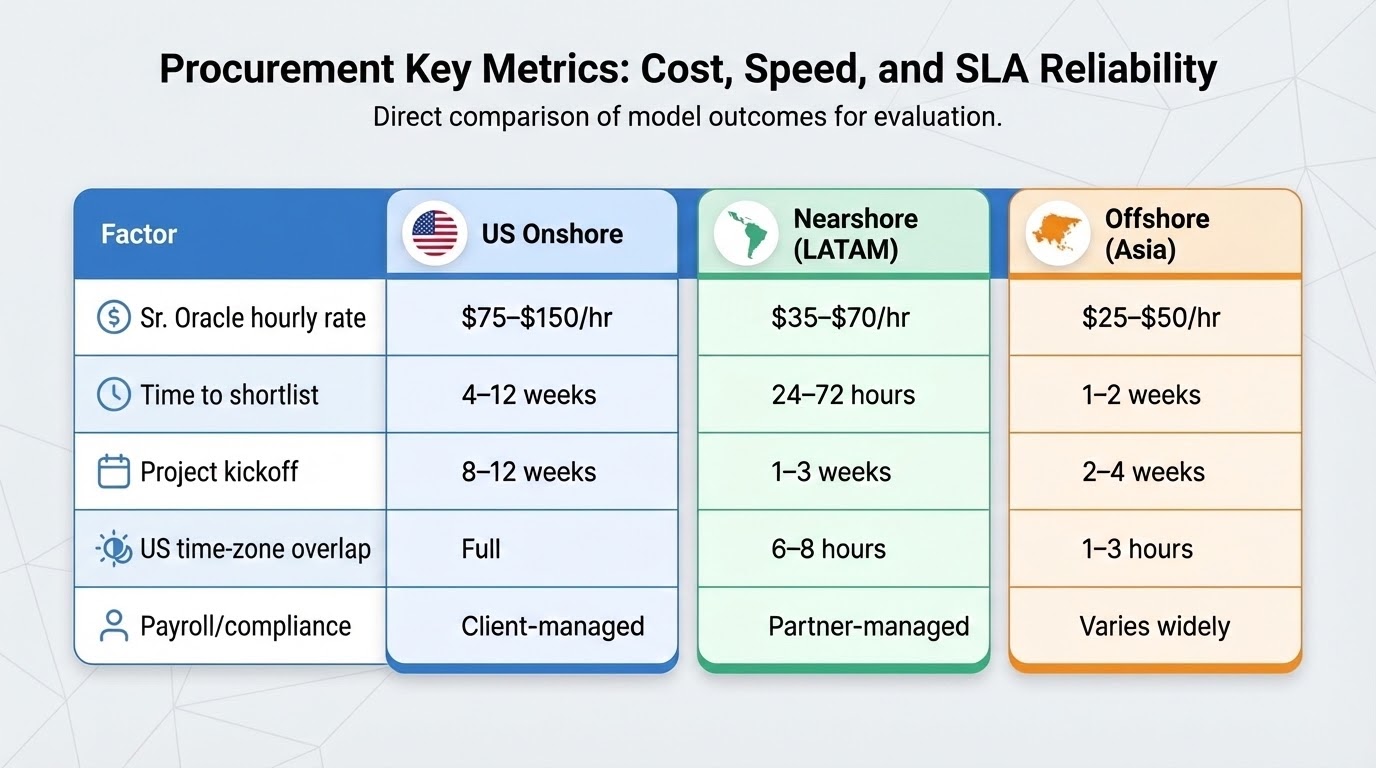
Rate data based on Fast Dolphin’s staffing benchmarks across the Americas. For a more detailed comparison, Fast Dolphin published a full cost and collaboration breakdown of nearshore vs. offshore vs. onshore models.
The cost gap between nearshore and offshore looks smaller than many procurement managers expect. But the total cost of engagement tells a different story. Offshore projects routinely accumulate hidden costs from rework caused by miscommunication, delayed feedback loops, and the management overhead of coordinating across a 10–12 hour time difference. Nearshore eliminates most of that friction.
Retention is another factor that doesn’t always make it into the rate card comparison but hits delivery hard when it goes wrong. US IT turnover has reached 37%, while LATAM nearshore providers report attrition rates below 12%, according to IT Convergence’s industry analysis. Every time a consultant leaves mid-project, you lose institutional knowledge, and the clock resets on ramp-up. Lower turnover means more stable teams and fewer disruptions to delivery.
Here’s where the nearshore model solves a problem that goes beyond Oracle talent itself.
Most vendor consolidation initiatives fail at the execution stage because the replacement partner can’t actually cover the breadth of roles that multiple vendors were handling. If you’re cutting your Oracle vendor panel from six suppliers to two, the partner that survives needs to deliver APEX developers, EBS functional consultants, Cloud architects, DBAs, and QA testers. Not just one of those. All of them.
If your organization runs an MSP or VMS program, this matters even more. The right nearshore partner can operate inside platforms like SAP Fieldglass or Beeline with the same controls, rate cards, and approval chains as your onshore vendors. Nearshore talent doesn’t bypass your governance. It plugs into it.
Fast Dolphin, for example, has worked with US enterprises for over 20 years across the Americas, and 80% of their clients return with new projects. That kind of repeat business doesn’t happen when the relationship is purely transactional. It happens when a partner becomes an extension of the procurement and IT teams they serve.
Not every nearshore staffing firm can handle Oracle work. General dev shops that list “Oracle” somewhere on their capabilities page aren’t the same as a partner with a proven track record and enterprise project experience. Here’s what separates the two when you’re evaluating options:
Run through that list with any vendor you’re evaluating. The answers will tell you quickly who can back up their claims and who’s stretching.
The conversation around Oracle staffing is shifting. It’s no longer just about finding someone who knows PL/SQL. For procurement, it’s about building a vendor relationship that scales across Oracle’s full technology stack, delivers predictable costs, and doesn’t add complexity to an already crowded supplier panel.
A nearshore Oracle team in LATAM, structured through the right partner, solves for all of that. You get the technical strength, the time-zone alignment, the cost efficiency, and the compliance handling, consolidated under a single, accountable relationship. And because nearshore staff augmentation is designed to flex with project demand, you’re not locked into long-term headcount commitments that don’t match your actual workload.
The firms that figure this out early are the ones that stop chasing Oracle talent reactively and start staffing proactively, with a partner that already has the people, the processes, and the track record to deliver.
Tell us what you need and we’ll get back to you with a plan:
Nearshore partners with Oracle strength can staff DBAs, APEX developers, ERP functional consultants across modules like Financials, SCM, and HCM, as well as Oracle Cloud architects, QA and testing specialists, and DevOps engineers. This applies to both legacy EBS environments and Oracle Cloud and S/4HANA migration projects. Teams can range from a single consultant to a full functional and technical squad.
Most companies see 40–60% savings on billing rates when moving from US-based Oracle contractors to nearshore equivalents. A senior nearshore Oracle consultant typically bills $35–$70 per hour versus $75–$150 onshore. Beyond the rate difference, you also save on recruitment overhead, since the staffing partner handles sourcing, vetting, and compliance.
Yes. MSP-ready nearshore partners operate within platforms like SAP Fieldglass and Beeline, following the same rate cards, SLA frameworks, and audit requirements as your onshore vendors. Nearshore talent integrates into your existing governance rather than creating a separate workflow.
Partners with pre-vetted Oracle talent pools can deliver candidate shortlists in 24–72 hours, schedule interviews within 3–5 days, and have consultants working on your project within 1–3 weeks. Compare that to the 8–12 week cycle that US-based Oracle hiring typically requires, and the speed difference is significant for projects with fixed deadlines.
The nearshore staffing partner acts as Employer of Record in each LATAM country where consultants are based. They manage local labor law compliance, payroll, taxes, statutory benefits, and IP protections. Your procurement and HR teams don’t take on additional administrative or legal exposure. Fast Dolphin, for instance, operates legal entities across the US, Canada, Mexico, Colombia, and Brazil.
Both. Nearshore staffing supports everything from single-consultant assignments to multi-year support contracts. It’s particularly effective for phased Oracle rollouts, where you need to scale up for an implementation wave and then scale back down without carrying permanent headcount. Engagements can be extended or released with proper notice, giving procurement the flexibility to match staffing to actual project demand.