


Your Salesforce customization backlog has been open for two months. The developer requisition went live in January. It is March, and three candidates made it to the final round. None of them accepted the rate. The CRM workflows that were supposed to go live before Q2 are still sitting in pre-development.
This is not a rare situation. Recruiting managers and HR directors at US companies run into the same problem across industries: Salesforce roles take too long to fill, cost too much to staff at domestic rates, and leave projects exposed when contractors walk mid-engagement. A nearshore Salesforce team from Latin America addresses all three, and faster than most HR leaders expect the first time they use the model.
Most companies that run into Salesforce delivery problems are not failing at strategy. The platform is chosen, the roadmap is approved, the business case has sign-off. What stalls projects is simpler: the right people are hard to find quickly and at a rate the project budget can support.
The Salesforce talent picture is more complicated than the headlines suggest. At the entry level, supply has outpaced demand for two consecutive years. The profiles that actually move CRM customization work forward are a different story.
Technical Architects, for example, make up just 1 percent of the global Salesforce talent pool, yet demand for that role grew 27 percent year-over-year in 2025, according to the 10k Talent Ecosystem Report via Salesforce Ben. That is the widest supply-demand gap of any Salesforce role. Focus on Force’s Q4 2025 analysis found that US Salesforce roles took several months on average to fill in the second half of 2025, even with job postings above 31,000 on Glassdoor alone. The difficulty is real, not perceived.
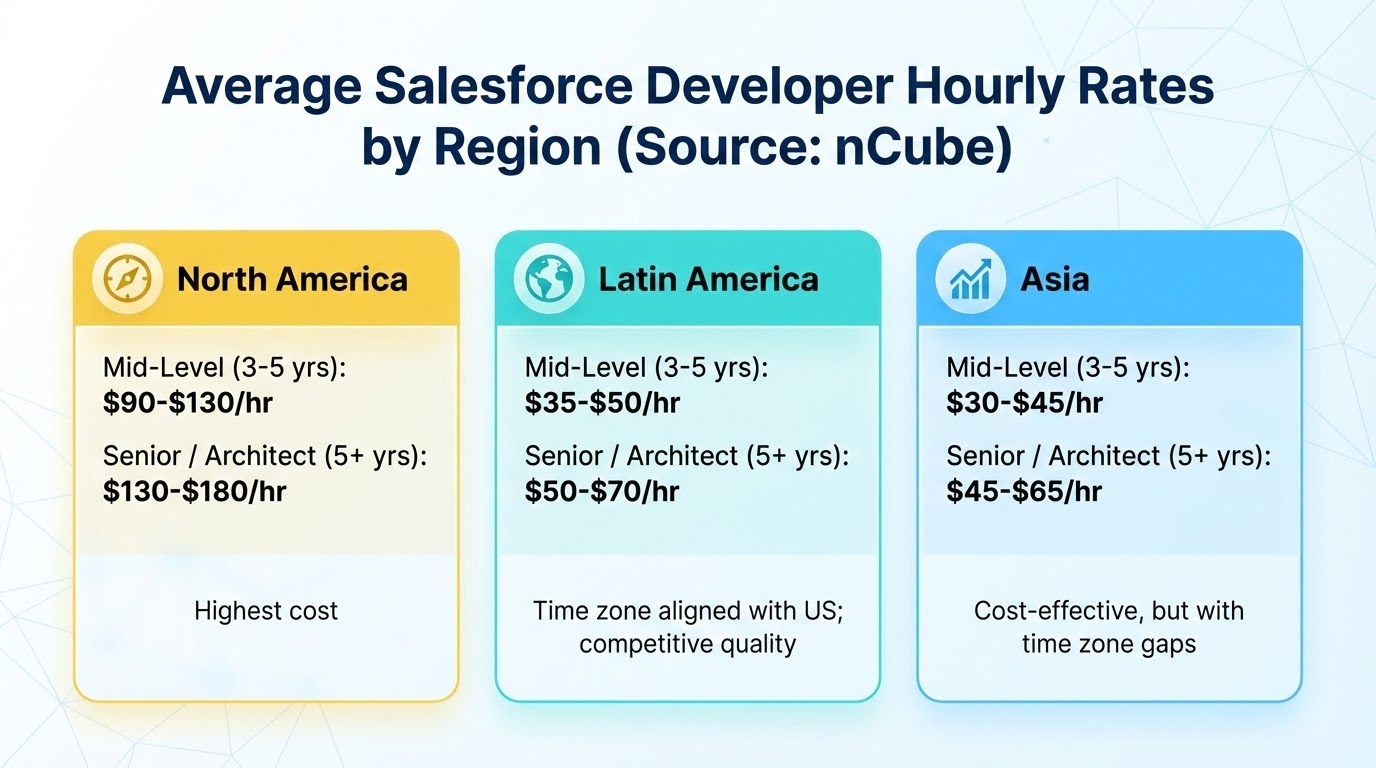
When specialized Salesforce talent does exist domestically, the rate card rarely fits. According to nCube’s rates comparison by region, North America Salesforce developers bill between $90 and $130 per hour at mid-level and $130 to $180 per hour at senior or architect level. At standard engagement volume, that translates to project labor costs that most mid-market budgets for subcontracted CRM work simply cannot absorb.
That is not a talent shortage in the traditional sense. The problem is a rate mismatch, and US-only sourcing has no answer for it.
Unlike a project handed off to an outsourcing vendor, a nearshore Salesforce team operates under the client’s direct control. With staff augmentation, architecture decisions, sprint planning, code review standards, and stakeholder communication all stay in-house. The nearshore team works as an embedded extension, attending standups, working the client’s hours, and reporting into the client’s project structure.
Typical roles on a nearshore Salesforce team include Salesforce Developers (Apex, Lightning Web Components), Administrators, Solution Architects, Business Analysts, QA Engineers, and Marketing Cloud or CPQ Specialists.
Engagement models range from individual temp contractors to full dedicated nearshore teams, with temp-to-permanent options for companies that want to evaluate a candidate before making a direct placement. The staffing partner handles local employment, payroll, and benefits in LATAM. The US client receives a single invoice and carries no direct employer-of-record exposure.
US Salesforce roles took several months on average to fill in the second half of 2025, per Focus on Force. Fast Dolphin’s quick response times mean candidate profiles reach you within 24 to 48 hours of the initial call, although it usually only takes a few hours.
That compression comes from maintaining active, pre-vetted talent pools in LATAM rather than starting each search from zero. If a project is already behind, that timeline difference is not incremental. It can mean the difference between recovering the quarter and missing it entirely.
Offshore development teams in India or the Philippines come with a structural limitation most project managers know well. You send a question at 9 AM, get an answer the following morning, discover a misunderstanding, and lose another day. For Salesforce customization work, where functional consultants and developers need daily alignment with business stakeholders, that lag compounds fast.
LATAM teams work within 1 to 3 hours of US time zones, so standups happen at normal business hours, code reviews get done during the workday, and escalations do not sit overnight. Research from Harvard Business School found that losing just one hour of time zone overlap between colleagues reduces synchronous communication by 11 percent on average, with the sharpest impact on teams doing complex, nonroutine work. For Salesforce customization, which depends on daily back-and-forth between developers and business stakeholders, that gap compounds quickly. See how US companies structure this model across technology projects.
According to nCube’s rates comparison by region, North America Salesforce developers bill $90 to $130 per hour at mid-level and $130 to $180 per hour at senior or architect level. Equivalent profiles in Latin America run $35 to $50 per hour at mid-level and $50 to $70 per hour at senior level, per nCube’s Salesforce developer rates by region. Both profiles are time-zone aligned with the US at competitive quality.
At 160 hours per month, a mid-level LATAM developer costs $5,600 to $8,000 compared to $14,400 to $20,800 for the same seniority in North America. At the senior or architect level, that gap widens further. That difference is often what separates a project budget that gets approved from one that gets restructured.
The cost difference reflects purchasing power and cost-of-living gaps in Latin America, not skill gaps. LATAM Salesforce professionals hold the same certifications and regularly staff projects for Fortune 500 companies. A full nearshore vs. offshore vs. onshore cost breakdown is available if you are running a vendor comparison internally.
Salesforce projects rarely have a flat resource curve. The needs during discovery and design look nothing like what is needed during UAT or post-go-live stabilization. Maintaining a full internal team through those transitions is expensive.
A nearshore staffing model lets clients add developers or admins for specific phases, extend contracts as scope shifts, and release resources without triggering severance or restructuring conversations. For HR leaders managing headcount caps, that flexibility has real operational value. Fast Dolphin’s temporary staffing model is structured specifically for this use case.
Managing payroll, taxes, statutory contributions, and employment contracts for contractors in Mexico, Colombia, or Brazil requires country-specific legal infrastructure that most US HR teams do not have and do not want to build.
Fast Dolphin operates across the Americas, handling local labor law compliance, payroll processing and billing, benefits, and employment contracts directly. The US client receives a single invoice. That structure matters especially for organizations running MSP or VMS programs, where vendor compliance and billing structure are as important as delivery speed.
Schedule a call to discuss how Fast Dolphin can deliver a pre-vetted nearshore Salesforce team for your project:
The offshore model can look attractive on a spreadsheet until you factor in the 10 to 12 hour time difference, rework cycles from misaligned requirements, and the management overhead of an async-only delivery model. Onshore removes those problems but reintroduces the rate and hiring speed issues.
Nearshore LATAM sits in the practical middle: not the cheapest option globally, but the one that holds up when you measure total project cost and delivery speed together. North America senior Salesforce developers bill at $130 to $180 per hour; offshore teams in Asia run $45 to $65 per hour at senior level but with 10 to 12 hour time zone gaps; nearshore LATAM lands at $50 to $70 per hour for senior profiles with full US time-zone overlap. For most Salesforce customization projects, that combination is the right trade-off.
Not every nearshore provider delivers at the same level, so it is worth asking three questions before signing any engagement:
Ask for certifications by role, not by company. A staffing partner that claims broad Salesforce expertise but can only produce Admin-certified contractors is not equipped for customization work. The profiles that actually move CRM projects forward, such as multi-cloud developers, CPQ architects, and MuleSoft integration specialists, require specific credentials and hands-on project history. Request a role-by-role breakdown of what the partner can realistically source in LATAM for your specific configuration before you commit.
A nearshore partner that relies on a third-party employer-of-record adds a layer of risk and opacity that creates problems downstream: billing disputes, compliance gaps, and limited recourse if something goes wrong. Ask directly whether the partner employs workers through its own legal entities in the countries where it sources talent. Fast Dolphin operates across the Americas with offices in the US, Mexico, Canada, Brazil, and Colombia, which gives clients clear contracts, transparent billing, and a single point of accountability.
Every nearshore provider will say they move fast, so ask for the actual benchmark: how many calendar days from role definition to first candidate shortlist? If the answer is vague, that tells you something. Fast Dolphin’s standard is 24 to 48 hours, and that specificity matters when a project is already in motion.
The process runs as follows:
This is the same staffing model Fast Dolphin uses for SAP S/4HANA projects and Oracle APEX engagements. The platform changes, but the staffing structure holds across all of them.
Salesforce projects do not stall because companies lack the tools or the budget to build what they need. They stall because finding the right talent quickly, at a rate that works, with continuity built in, is harder than it should be in the US market.
A nearshore Salesforce team from LATAM is a practical answer to that specific problem. It is not a workaround or a compromise on quality, but a staffing model calibrated for exactly the gap between what US-only sourcing can deliver and what the project actually needs.
If a 30-minute conversation with Fast Dolphin’s team is worth your time, the calendar is open.
The process runs as follows:
This is the same staffing model Fast Dolphin uses for SAP S/4HANA projects and Oracle APEX engagements. The platform changes, but the staffing structure holds across all of them.
Salesforce projects do not stall because companies lack the tools or the budget to build what they need. They stall because finding the right talent quickly, at a rate that works, with continuity built in, is harder than it should be in the US market.
A nearshore Salesforce team from LATAM is a practical answer to that specific problem. It is not a workaround or a compromise on quality, but a staffing model calibrated for exactly the gap between what US-only sourcing can deliver and what the project actually needs.
If a 30-minute conversation with Fast Dolphin’s team is worth your time, the calendar is open.
Get in touch with Fast Dolphin to discuss your Salesforce staffing needs and receive candidate profiles within 24 to 48 hours:
In most cases, Fast Dolphin delivers initial candidate shortlists within 24 to 48 hours of the initial call, although it usually only takes a few hours. This is significantly faster than the several months US Salesforce roles took on average to fill in the second half of 2025, per Focus on Force.
Yes, LATAM-based professionals work within 1 to 3 hours of US time zones (EST, CST, MST, PST), which enables daily standups, live UAT sessions, and same-day issue resolution without asynchronous delays.
Strong nearshore staffing partners can source certified professionals across Sales Cloud, Service Cloud, Marketing Cloud, CPQ, MuleSoft, and core platform developer credentials. Ask for certification specifics by role before the engagement starts, not once candidates have already been presented.
It depends on the engagement model. For contract and temporary roles, Fast Dolphin acts as the Employer of Record, handling payroll, local labor law compliance, statutory contributions, and employment contracts directly through its offices in the US, Mexico, Canada, Brazil, and Colombia. The US client receives a single invoice. This structure is also compatible with MSP and VMS frameworks. For permanent placements, Fast Dolphin’s role is that of a recruiter: once you select your candidate, the offer and employment contract are executed directly by your company under your own terms. Since this article focuses on contract and nearshore team engagements, the Employer of Record model is what applies throughout.
Yes, with the right contractual framework in place. Proper IP protections, data privacy alignment, and compliance documentation allow nearshore Salesforce teams to operate effectively in healthcare, financial services, manufacturing, and utilities. Verify your partner’s compliance infrastructure before engaging, not during.
A consulting partner owns the delivery, assigning resources at their discretion, managing work through their own structure, and billing by project or statement of work. Staff augmentation gives the client direct control: you select the profiles, set the workflows, own the architecture decisions, and the staffing partner handles employment and payroll in the background. Staff augmentation is typically faster to stand up, easier to scale, and more cost-transparent than a full consulting engagement.