


Cloud project pipelines are full. The engineers to staff them aren’t. If you’re a CTO or VP of Technology trying to deliver AWS migrations, Azure infrastructure work, or DevOps modernization for US clients, you’ve probably already run the numbers: domestic cloud specialists are in short supply, billing rates are high, and typical hiring timelines stretch well past two months.
The default move for many IT leaders has been to go offshore. It looks compelling on paper. But the reality of running cloud work across a 10-plus-hour time difference tends to catch up quickly, and when it does, it hits delivery timelines and client confidence at the same time.
Nearshore cloud engineering teams from Latin America offer a different answer. This article breaks down why they’re a better fit for AWS and Azure projects specifically, what to look for in a staffing partner, and what the numbers actually look like.
Cloud spending is growing faster than the workforce supporting it. Global cloud spending is projected to reach $723.4 billion in 2025, up more than 21% from the prior year. Enterprises are moving AI workloads, data infrastructure, and core business systems onto AWS and Azure. The demand for people who can build and manage those environments is rising right along with it.
The hiring data confirms what most IT leaders are already feeling. AWS skills appeared in 40% of cloud job postings in 2024, while Azure climbed to 34%, up from just 21% in 2017. Both numbers are rising simultaneously, which means companies need engineers fluent across platforms. That combination is genuinely hard to find.
87% of US tech leaders report difficulty sourcing skilled workers, with cloud engineering near the top of that list. Robert Half consistently places cloud engineers in the top 15% of most in-demand IT roles. Meanwhile, US cloud engineers average more than $129,000 in base salary per year, with senior architects clearing $190,000 or more. For IT services firms staffing US client engagements, those rates compress project margins fast.
The cost savings on paper rarely survive contact with reality on cloud work. Here’s what actually happens.
Cloud engineering is inherently time-sensitive. A firewall misconfiguration surfacing during a morning deployment can’t sit in a ticket queue for 12 hours. An architect catching up from async notes during a sprint review is making decisions without full context. Those gaps compound across a project.
Collaboration quality takes a hit too. Cloud migrations, infrastructure builds, and DevOps modernization all require real back-and-forth: fast decisions, clarifying questions, and live troubleshooting during deployments. Teams operating in non-overlapping windows lose that, and the communication overhead ends up slowing exactly the work that needs to move quickly.
Quality is a separate issue from scheduling. Many IT leaders who’ve tried offshore providers for cloud work report that the technical output doesn’t meet the standards US clients expect, particularly around AWS and Azure certifications, infrastructure-as-code practices, and CI/CD pipeline design. Reworking deliverables because of that gap often costs more than the initial rate differential saved.
For a detailed breakdown of how the models compare on cost, speed, and risk, see this nearshore vs. offshore vs. onshore cost and collaboration comparison.
Most LATAM countries sit within 1 to 3 hours of US Eastern time. In practice, that means 6 to 8 shared working hours with US teams every day. Engineers join morning standups, review pull requests during business hours, and respond to production incidents without handoff delays. For cloud and DevOps work specifically, that proximity produces measurable differences in delivery speed and issue resolution time.
Fast Dolphin places bilingual professionals who communicate in English as a standard, not an exception. That matters beyond just language. It means engineers can engage in architectural discussions, write technical documentation, join client-facing calls when needed, and escalate issues clearly. That’s a different working dynamic than managing the additional communication layer that typically comes with offshore engagements.
LATAM cloud engineers work with the same tools and certifications as their US counterparts: AWS Certified Solutions Architects, Azure DevOps engineers, Terraform and infrastructure-as-code specialists, Kubernetes and Docker practitioners, and CI/CD engineers across platforms including GitHub Actions, Jenkins, and GitLab. This is not generalist IT talent rebranded for cloud work. For a closer look at what this talent profile delivers in practice, see why US companies choose nearshore dedicated development teams.
Agile works when the team is actually present. Sprint planning, standups, retrospectives, and live code reviews all depend on real overlap. Nearshore IT staff augmentation gives you engineers who share the same working window as your US client teams, which keeps delivery predictable and sprint velocity consistent. For DevOps specifically, real-time availability isn’t optional. Deployments, incident response, and infrastructure changes require someone who can act now.
A senior cloud engineer in the US typically bills between $75 and $150 per hour for contract work. A nearshore engineer from LATAM with comparable experience and certifications typically runs $35 to $70. That 40 to 60% savings figure doesn’t reflect a skill difference. It reflects the cost-of-living gap between the two markets. LATAM engineers work regularly with Fortune 500 companies and enterprise-grade cloud environments. The rate differential doesn’t come with a capability trade-off, which is where offshore alternatives often fall short.
Filling a senior US cloud role typically takes two to three months. Nearshore staffing models built around delivery speed cut that considerably. Fast Dolphin delivers candidate shortlists within 24 to 72 hours and gets engineers working on projects within 7 to 14 days. That timeline matters when a new engagement has already been scoped and signed. Slow staffing pushes start dates, and pushed start dates put client relationships at risk.
Schedule a call and get a shortlist of vetted cloud engineers in days, not months.
How US onshore, offshore, and nearshore LATAM compare across the factors that matter most for AWS and Azure projects:
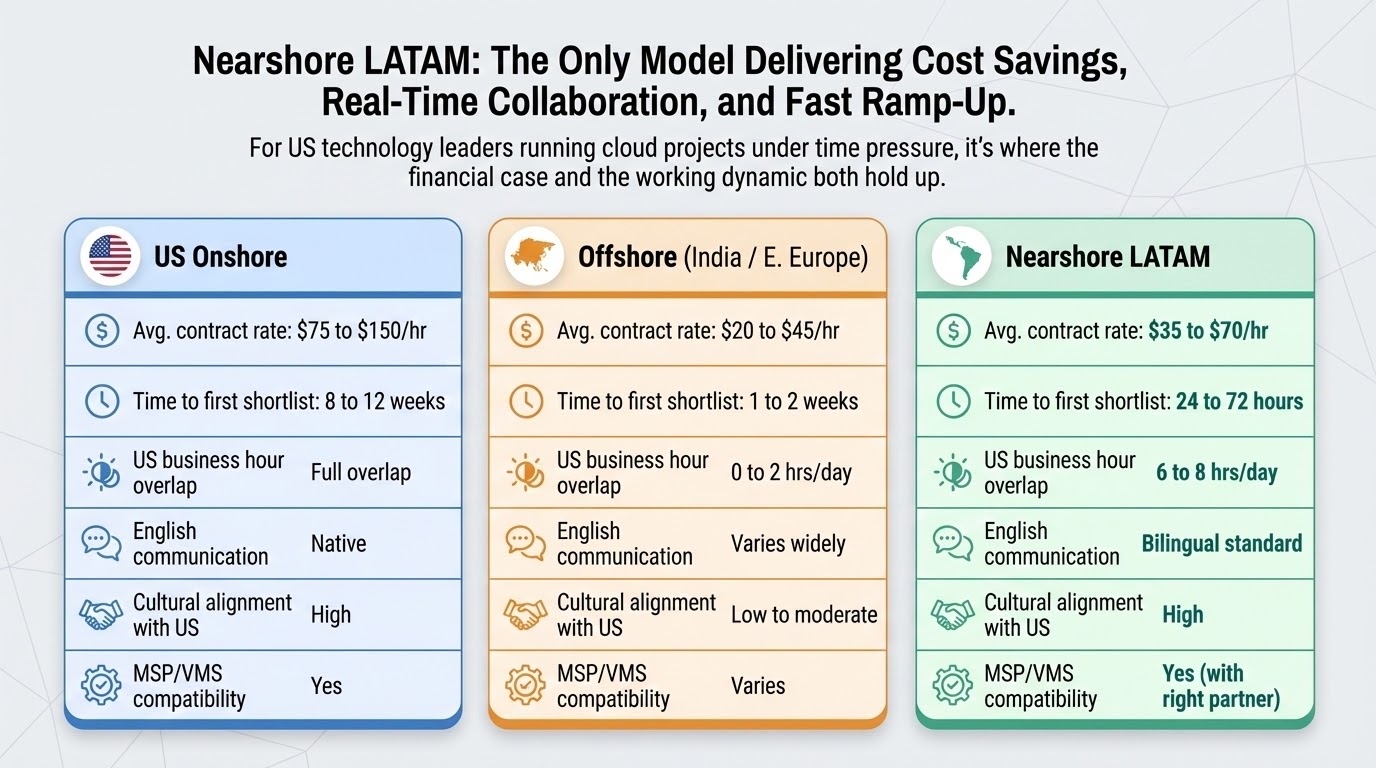
Nearshore LATAM is the only model that delivers cost savings, real-time collaboration, and fast ramp-up at the same time. For US technology leaders running cloud projects under time pressure, it’s where the financial case and the working dynamic both hold up.
Not all nearshore providers deliver the same results, and the gaps tend to show up quickly on cloud projects.
Vetting should be role-specific. General IT screening doesn’t tell you whether an engineer has hands-on experience deploying Terraform modules, configuring AWS IAM policies, or building Azure DevOps pipelines. Ask how candidates are assessed for the specific cloud tools and certifications your project requires.
Time zone coverage should be confirmed, not assumed. LATAM spans Mexico, Colombia, Brazil, Argentina, and more. Make sure your partner’s talent network is concentrated in countries that actually share meaningful working hours with US teams.
Payroll and labor compliance across LATAM countries is genuinely complex. A strong partner manages this directly, so your procurement and legal teams don’t carry that burden. Integrating a nearshore team into an MSP or VMS environment should be operationally clean from the start, with rate cards, SLAs, and approval workflows fully supported.
Engagement flexibility matters too. Cloud projects change scope, grow, and wind down. A staffing model that can adjust without forcing you into permanent headcount decisions gives you the room to respond to those changes cleanly.
Fast Dolphin has been placing IT professionals across the Americas for more than 21 years. Cloud and DevOps engineers are part of a broader technology practice that includes SAP, Oracle, Salesforce, Data, and QA, which means we understand enterprise project environments and how cloud roles fit within them.
Our temporary tech staffing model is built for speed and flexibility. We deliver shortlists of pre-vetted, bilingual cloud engineers within 24 to 72 hours. Engineers are operational in 7 to 14 days. Payroll and labor compliance across LATAM are handled on our end, and we’re experienced in MSP and VMS environments including SAP Fieldglass and Beeline.
80% of our clients return with new projects. That number reflects what consistent staffing delivery actually produces: projects that start on time, client relationships that hold, and margins that look the way they were planned.
If you’ve won new AWS or Azure work and need to staff it quickly, or if you’re looking to reduce what you’re spending on US subcontractors without sacrificing collaboration quality, the nearshore model is worth a serious look.
Contact Us and tell us what you need. We’ll come back with a shortlist of pre-vetted AWS and Azure engineers faster than you’d expect.
A nearshore cloud engineering team is a group of cloud engineers based in nearby countries, typically Latin America for US companies, who work within overlapping time zones and integrate directly into your existing workflows. They handle AWS and Azure infrastructure, DevOps pipelines, cloud migrations, and related technical work as an extension of your internal team rather than as a disconnected delivery center.
The primary difference is time zone alignment. Offshore teams in India or Eastern Europe typically operate 8 to 12 hours ahead of US time, which limits real-time collaboration to a narrow window at best. Nearshore teams in LATAM share 6 to 8 hours of the US business day, enabling live standups, same-day code reviews, and responsive incident support throughout the working day.
Yes. Engineers in Mexico, Colombia, Brazil, and Argentina work within 1 to 3 hours of US Eastern time. Full overlap with US business hours is standard, and Fast Dolphin specifically places professionals aligned to US client schedules.
Fast Dolphin typically delivers candidate shortlists within 24 to 72 hours of engagement. Engineers are usually operational within 7 to 14 days, depending on role complexity and project requirements. That’s a significant improvement over the two-to-three-month timeline typical for US-based cloud specialist hiring.
Common roles include AWS and Azure cloud architects, DevOps and site reliability engineers, Terraform and infrastructure-as-code specialists, Kubernetes and Docker practitioners, CI/CD engineers, cloud security engineers, and data engineers with cloud platform experience. Bilingual professionals are available across seniority levels, from mid-career practitioners to senior architects.
Yes. A qualified nearshore staffing partner can operate fully within MSP and VMS frameworks, including SAP Fieldglass and Beeline, following your existing approval workflows, rate card structures, and compliance requirements. Fast Dolphin has experience in enterprise procurement environments and can be onboarded as a compliant vendor within those systems.