

US companies are investing heavily in data and AI, but hiring the talent to execute it is a different problem. Demand for specialized roles continues to outpace supply, senior positions take months to fill through traditional channels, and the budgets required to staff data teams domestically are increasingly hard to justify.
Latin America has become the answer for a growing number of US enterprises. This article breaks down what a nearshore data engineering team actually looks like in practice, where the cost and speed advantages come from, and what IT leaders need to know before bringing one on board.
The phrase “data engineering team” covers considerably more ground than it did five years ago. It used to mean people who moved data from one place to another. Today, a functional team touches pipeline architecture, cloud infrastructure, analytics modeling, machine learning, and increasingly, the AI systems built on top of all of it. Before hiring for any of these roles nearshore, it helps to be clear on what you are building.
Data engineers form the foundation. They build and maintain the pipelines that move, transform, and load data. In most modern stacks, that means working with Apache Spark, Apache Airflow, dbt, Kafka, and cloud-native services across AWS (Glue, Redshift), GCP (Dataflow, BigQuery), and Azure (Data Factory, Synapse). Mexico, Colombia, Brazil, and Argentina all have large communities of engineers with hands-on enterprise experience in these tools.
Analytics engineers sit at the intersection of data engineering and business intelligence. They build the data models that analysts and business users actually query, typically in dbt against a warehouse like Snowflake, BigQuery, or Databricks. This role has grown significantly over the past four years, and LATAM has kept pace with that demand.
Cloud data architects design the broader infrastructure: how data flows across systems, how the warehouse integrates with source applications, and how the stack is governed and secured. These tend to be senior roles with specific platform expertise, and they are available in LATAM, though the search is more targeted.
Since 2023, demand for AI and ML engineers has grown faster than almost any other technology role. According to the Stanford HAI 2025 AI Index Report, 78% of organizations reported using AI in 2024, up from 55% the year before. Over that same period, the number of US computing graduates grew just 22% over the last decade, meaning the engineers needed to build and operate those systems are in short supply across the US market. The roles US enterprises most commonly need include:
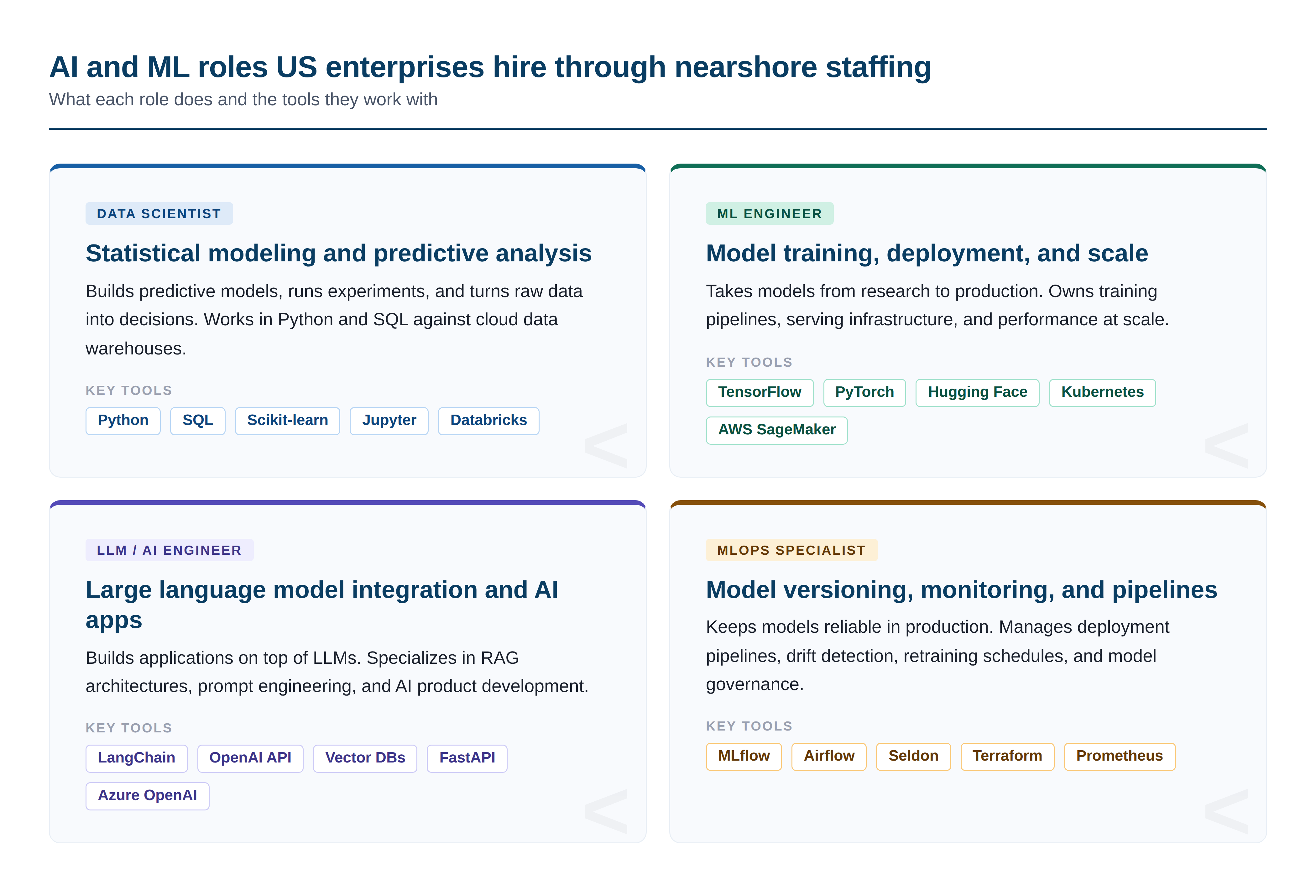
Not every company needs all of these at once. Most data teams start with a core of two to four data engineers and an analytics engineer, then add ML capability as the analytics foundation matures. Fast Dolphin can staff a single role or a full team, and the model scales in either direction.
If you are weighing how to structure the team before bringing in nearshore IT staff augmentation, it is worth getting that conversation started early. The shape of the team often shifts once you see what is available in the market.
Why US Enterprises Are Moving Data Work Nearshore
There are four reasons this conversation keeps coming up with US data and engineering leaders, and they are all grounded in practical operations rather than abstract strategy.
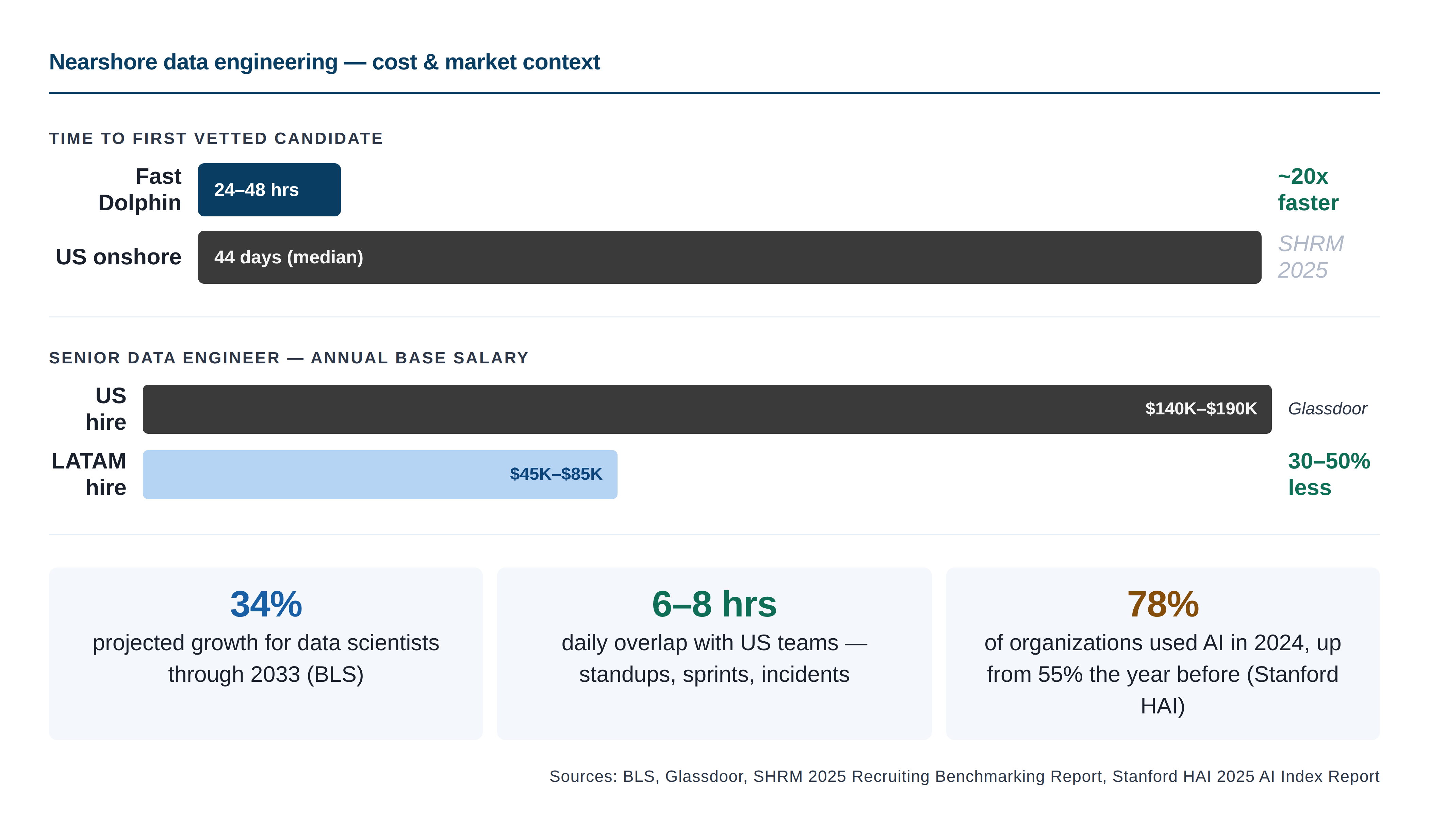
The BLS projects 34% growth in data scientist roles through 2033. According to the SHRM 2025 Recruiting Benchmarking Report, the median time-to-fill across US organizations is 44 days from requisition to accepted offer. That is 44 days of deferred analytics capability, and a meaningful amount of IT bandwidth spent managing an open search.
A senior data engineer in the US earns $140,000 to $190,000 in base salary. Comparable professionals in Mexico, Colombia, or Brazil typically earn $45,000 to $85,000 depending on seniority and specialization. For a team of five data engineers, that difference is a seven-figure annual figure before benefits, payroll taxes, or recruitment costs are added. Fast Dolphin clients consistently see 30 to 50% savings against equivalent North American hiring.
This point gets underestimated until you have tried offshore. When your data team is 9 to 13 hours ahead, async handoffs become the default: slower debugging cycles, documentation lag, and a lot of issues that sit overnight before anyone picks them up. A nearshore team operating in US Central, Eastern, or Pacific time can join your standups, pair with your internal engineers, and work through an incident in the same day it starts. For teams running daily pipelines or supporting live analytics dashboards, that difference is real. The broader impact on how nearshore staffing accelerates IT delivery goes well beyond the time-zone advantage alone.
Fast Dolphin screens every candidate on English proficiency. The LATAM professionals we place are bilingual and work directly with US stakeholders without interpretation friction. For data teams, where precision in communication about schemas, data definitions, and business logic is not optional, that matters from day one.
Offshore is cheaper. Onshore is simplest when in-person work is required. Nearshore is the right answer when you need cost savings over domestic hiring and real-time collaboration quality. For a full breakdown of the trade-offs across these three models, see our detailed guide to nearshore vs. offshore vs. onshore IT staffing.
Nearshore costs more than offshore and less than onshore. That premium buys you same-timezone collaboration, bilingual communication at a US business standard, and through Fast Dolphin’s nearshore IT and engineering staffing service, you receive a vetted candidate shortlist within 24 to 48 hours of submitting a role description, compared to a median of 44 days for a traditional US hire. For most US data teams, that trade-off is straightforward.
Most of the friction that comes with adding a nearshore staffing partner has nothing to do with the talent itself. It comes from the operational handshake between your internal systems and theirs. Sorting this out before the first contractor starts saves significant downstream work.
Most enterprise IT environments process contractor data through a Vendor Management System or HRIS, tools like Beeline, SAP Fieldglass, Workday, or Oracle HCM. When you add a new staffing partner, someone on your IT team will need to configure how contractor records flow in: profile data, assignment details, rate information, and work location. The cleaner the partner’s data format, the less manual reconciliation your team absorbs. If your organization runs a formal MSP program, the setup process follows a structured pattern covered in detail in our guide to integrating nearshore teams into MSP and VMS programs.
Ask any prospective staffing partner upfront: what formats do you deliver contractor data in? Can you export to CSV with standardized field names? Do you support API-based data feeds? Fast Dolphin bills in USD across all engagements and provides structured invoicing data that maps consistently to client systems, but every IT environment is different, and this conversation should happen early.
Accurate time-tracking for nearshore consultants is straightforward, but only when it is set up correctly from the start. The key questions: What time-tracking system will the contractor log hours in, yours or the partner’s? Who approves timesheets? How does an approved timesheet flow into invoice generation, and what is the expected billing cycle?
Fast Dolphin handles payroll and invoicing on our end regardless of where we are in the client billing cycle. For clients, that means a predictable monthly invoice tied to approved hours, billed in USD, with no surprises.
Vendor onboarding deserves the same scrutiny as any third-party system access. Key questions for your evaluation checklist: Does the partner have a documented data handling policy? What are the procedures for offboarding consultants and revoking system access? Do they require NDAs as part of the consultant engagement? The NIST Cybersecurity Framework provides a solid baseline for the vendor security categories worth covering in any onboarding review.
One of the most common IT headaches in multi-partner staffing environments is inconsistent data formats, different field names, date structures, rate configurations, and contractor categories coming in from separate sources. The result is manual reconciliation work that lands on the IT team.
The fix is not complicated, but it requires the conversation to happen before onboarding, not after. Build a short data specification document covering field names, formats, and required fields, and share it with the partner before the first engagement begins. Any staffing partner worth working with will accommodate it.
Fast Dolphin has been placing bilingual LATAM IT and Engineering professionals for over 20 years across five countries. You tell us the role, stack, and seniority level. We deliver a vetted shortlist in 24 to 48 hours, screened for both technical fit and English proficiency. Our temporary staffing service covers everything from a single data engineer to extend your team to a broader data function built from scratch. Fast Dolphin handles payroll and employment in the consultant’s country and bills clients in USD, so your IT and HR teams absorb none of the administrative overhead.
The companies making real progress on analytics are not always the ones with the largest budgets. They are the ones that figured out how to build their nearshore data engineering team faster and more cost-effectively than the alternatives. LATAM has the talent, the time-zone argument holds up in practice, and the cost difference against North American hiring is real and consistent.
If you need vetted, bilingual LATAM data engineers without the six-month wait, reach out. No jargon, no hard sell.
Whether you are evaluating nearshore staffing for the first time or looking to expand an existing team, let us know what you are working on.
A nearshore data engineering team sources talent from countries in geographic and time-zone proximity to the US, primarily Mexico, Colombia, Brazil, and Argentina. The key operational difference from offshore, typically India or Southeast Asia, is scheduling: nearshore engineers work during US business hours, join standups in real time, and communicate in English at a standard suited to direct stakeholder interaction. Offshore teams are generally less expensive, but the 9 to 13 hour time difference changes how the team functions day to day, particularly for data work that requires fast iteration and close collaboration with business users.
LATAM has strong talent across the full modern data stack. Companies most commonly hire data engineers for pipeline development and ETL/ELT work, analytics engineers for data modeling in Snowflake, BigQuery, or Databricks, cloud data architects, data scientists, ML engineers, and LLM or AI engineers. Availability varies by role and market, but data engineers and analytics engineers are broadly available across LATAM. For a breakdown of what roles look like in practice, see the Stanford HAI 2025 AI Index Report for LATAM developer skill profiles.
A senior data engineer in the US earns $140,000 to $190,000 in base salary, per current Glassdoor data. Comparable professionals in LATAM typically earn $45,000 to $85,000 depending on seniority and specialization. Fast Dolphin clients consistently report 30 to 50% cost savings compared to equivalent North American hires.
Fast Dolphin delivers a vetted candidate shortlist within 24 to 48 hours of receiving a role description. Interview-to-offer timelines depend on your internal process. Most clients complete technical interviews and extend offers within one to two weeks of receiving candidates. Onboarding, including system access provisioning on the client side, typically adds another one to two weeks. Standing up a team of four to six engineers usually takes four to six weeks from initial scope to first engineers actively contributing.
LATAM data engineers are fluent in the tools that define the modern data stack. Cloud platforms include AWS (Glue, Redshift, EMR), GCP (BigQuery, Dataflow, Pub/Sub), and Azure (Data Factory, Synapse, Databricks). For orchestration, Apache Airflow and Prefect are common. Streaming work typically uses Apache Kafka or Spark Streaming. Transformation is predominantly dbt. Warehouses cover Snowflake, BigQuery, Databricks, and Redshift. Most senior candidates have multi-cloud experience and can be screened specifically for your stack.
Yes, and this is the most common scenario. Most Fast Dolphin clients have internal data teams and bring in nearshore engineers to extend capacity, fill a specialized role they cannot source quickly, or accelerate a specific project without committing to permanent headcount. Nearshore IT staff augmentation works alongside your existing team, following your processes, tools, and standards. It is an extension model, not a replacement.
The standard considerations for any third-party IT contractor apply: NDAs, access provisioning policies, offboarding procedures, and clear data handling guidelines for client systems. Fast Dolphin requires NDAs as part of every consultant engagement. On the IT team’s side, building a short vendor onboarding checklist that covers data format standards, system access scope, and invoicing process before the first contractor starts saves significant reconciliation work. The NIST Cybersecurity Framework is a useful reference for vendor risk categories worth reviewing.