

A QA gap does not stay quiet. It shows up in delayed releases, defects that reach production, and test coverage that keeps slipping because there is nobody to maintain it. Hiring experienced QA automation engineers in the US is slow and expensive, and the market is not getting easier.
A nearshore QA team built with professionals from Latin America changes that equation. Same time zones, the same tools your developers already use, technically vetted before any profile reaches you, and onboarded in weeks rather than months. Here is what the model actually looks like.
Most conversations about QA automation start with tools. Selenium or Cypress? Should we adopt Playwright? Those are valid questions, but they are downstream of a more immediate problem: you cannot build a reliable automation function without the people to write, maintain, and extend it.
The hiring market makes the problem concrete. According to the SHRM 2025 Recruiting Benchmarking Report, the median time-to-fill across US organizations is 44 days from requisition to accepted offer. For specialized QA automation roles, that timeline typically runs longer. When the QA seat sits open, the backlog does not hold: manual testers get stretched thin, automation coverage slips, and critical test paths go unverified. By the time a release is delayed or a production defect reaches a customer, the staffing gap that started it has already cost more than a recruiter fee.
Salary expectations compound the pressure. According to Glassdoor, US QA automation engineers earn between $95,000 and $120,000 per year on average. They compete for the same talent pool as software developers and carry comparable offer expectations. The Bureau of Labor Statistics projects demand for software developers and QA analysts to grow 15 percent through 2033, which means the US supply gap is not closing on its own. For HR Directors managing headcount costs against revenue targets, the domestic hiring math for QA keeps getting harder to defend year over year.
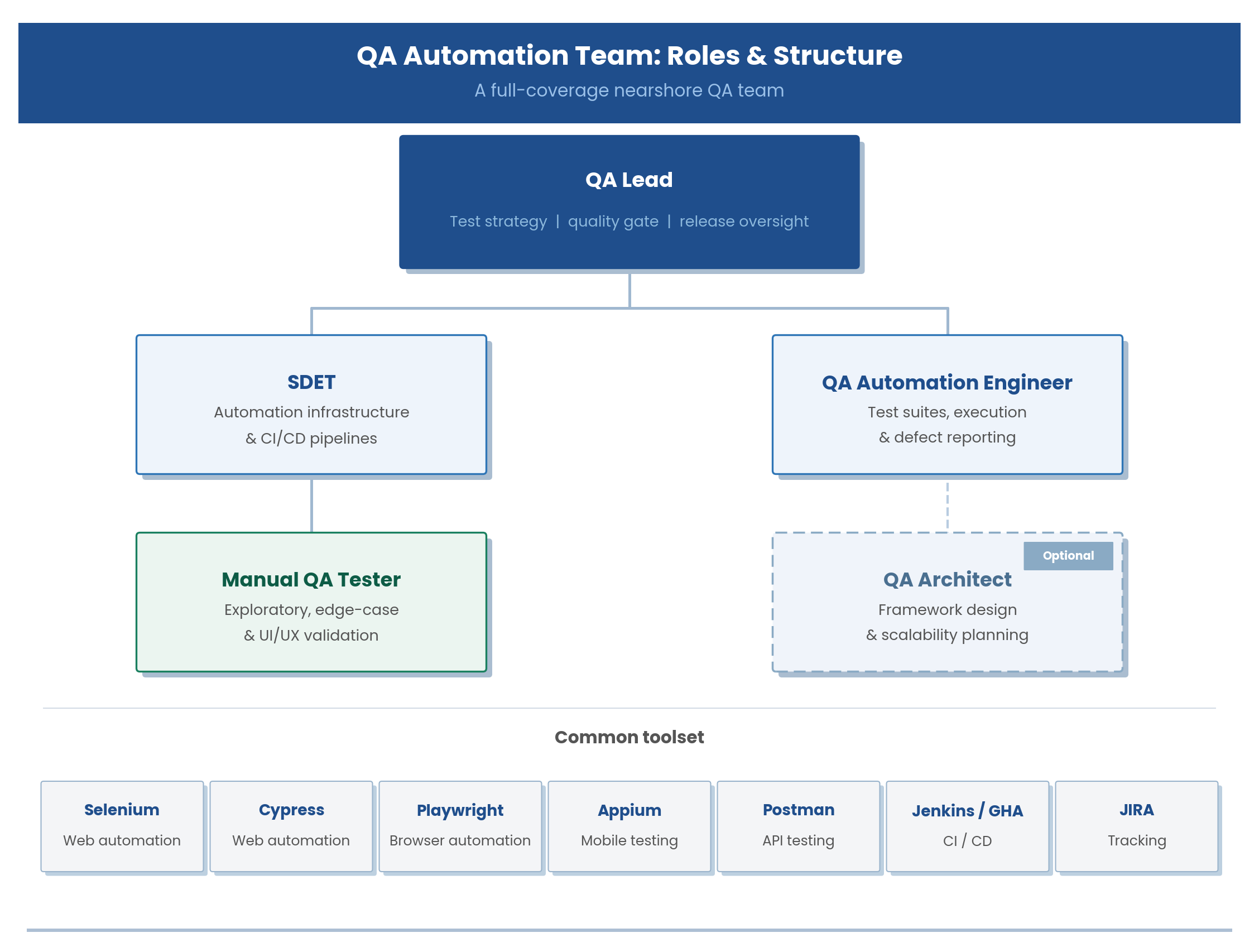
A nearshore QA team is not a single contractor. For most US companies, it is a structured group of professionals covering distinct functions within the quality engineering organization. Understanding what those roles are, and what each one does, is the first step in evaluating whether the model fits your current gap.
The toolset on a nearshore QA team matches any US-based QA function. The most common automation frameworks: Selenium and Cypress for web testing, Playwright for modern browser automation, Appium for mobile, and Postman and REST Assured for API testing. On the CI/CD side, Jenkins and GitHub Actions handle test execution in the pipeline.
Fast Dolphin screens every candidate for technical proficiency and English fluency before submitting any profile to a client. The professionals Fast Dolphin places work within the same JIRA, Confluence, GitHub, and Slack environments as US engineering teams. Onboarding starts from your sprint cadence and test backlog, not from standing up new tools.
The numbers make a direct argument. US QA automation engineers earn between $95,000 and $120,000 per year on average, and that is before benefits, employer taxes, and recruiter fees. Fast Dolphin clients have consistently saved 50-60% compared to equivalent US contractor or full-time costs when staffing QA automation roles through the nearshore model.
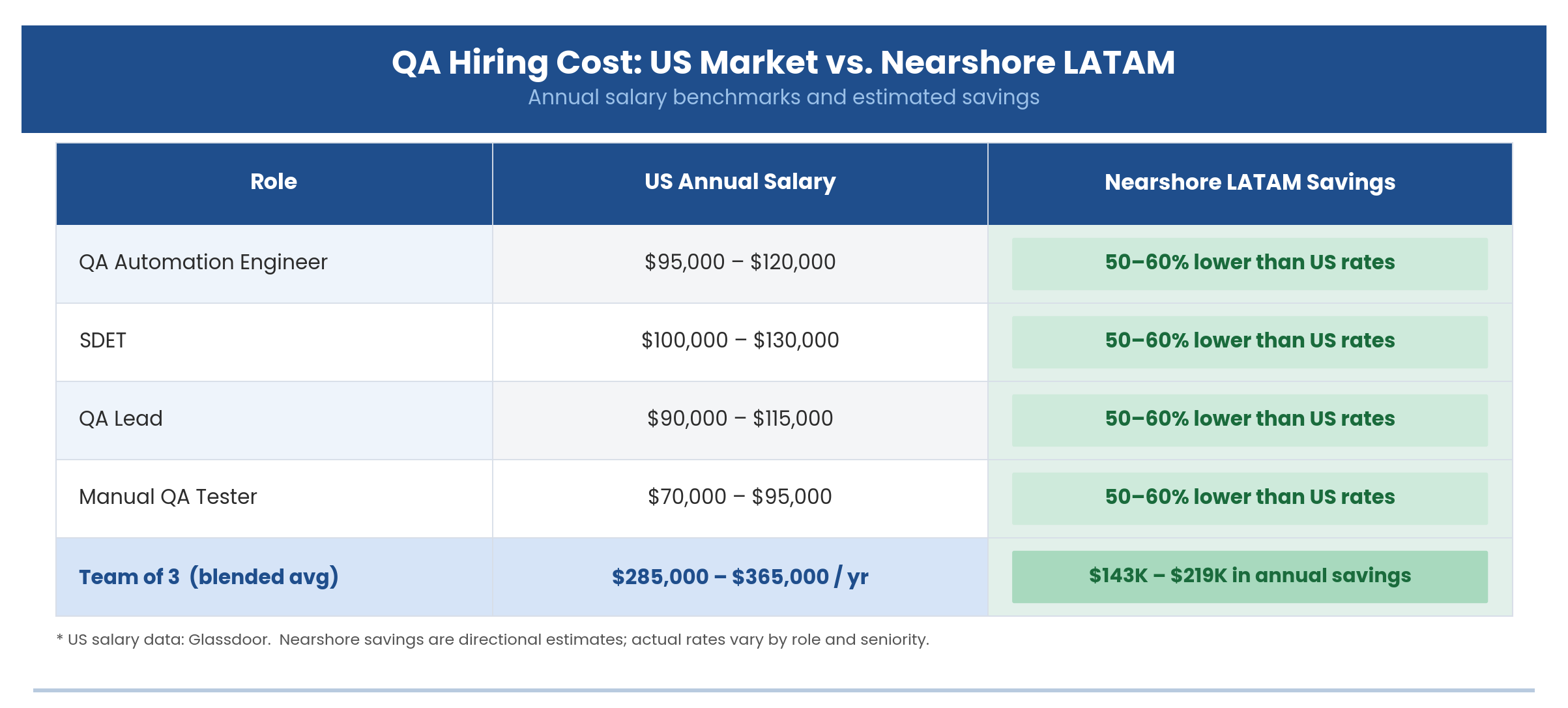
To put that in practical terms: a single mid-level QA automation engineer at US market rates runs roughly $110,000 to $130,000 all-in annually. The same profile placed by Fast Dolphin through the nearshore model typically comes in at roughly half that figure. For a team of three, the difference represents a meaningful budget reinvestment, whether that goes toward tooling, test infrastructure, or closing another open headcount gap.
The savings extend beyond the salary line. Faster time-to-fill directly reduces the cost of open headcount days. Fast Dolphin’s standard is to deliver a vetted candidate shortlist within 24 to 48 hours of receiving a role description. That compresses the time between approved headcount and contributing team member from months to weeks, which matters when a QA gap is already affecting release cadence.
Fast Dolphin can walk through what is available and how quickly we can move. No commitment, no generic pitch.
The first concern most engineering leaders raise about nearshore staffing is timezone. It is worth addressing directly.
Latin America operates within 0-2 hours of US Eastern time and within 3-4 hours of Pacific time. Mexico City, Bogota, and Sao Paulo are all workday-compatible with teams in New York, Chicago, Dallas, and Atlanta. For West Coast teams, the overlap narrows by a couple of hours but still supports morning standups, afternoon code reviews, and same-day defect triage.
In practice, a nearshore QA professional joins the same daily standup as your US developers, reviews pull requests in GitHub, logs defects in JIRA, and communicates in English over Slack or Microsoft Teams. Fast Dolphin’s bilingual screening means English fluency is confirmed before a profile is submitted, so there is no language gap to manage after the hire. The onboarding conversation starts from your codebase, test strategy, and sprint process.
Typical ramp-up from contract signature to active sprint participation runs two to four weeks, depending on codebase complexity and your team’s onboarding process. For more on how Fast Dolphin approaches nearshore DevOps and QA teams more broadly, including a practical comparison of US direct hire vs. nearshore on the metrics that matter, that post covers the same ground from an operations angle.
There is a trap some companies walk into when they try to reduce QA costs independently: they piece together a function from individual freelancers or small testing agencies, manage three separate contracts, deal with inconsistent quality across them, and have no clear owner when a critical defect gets through. The initial savings disappear in the management overhead.
The compliance picture makes it worse. Misclassifying a long-term contractor as a 1099 vendor is a genuine legal exposure for US companies. Nearshore freelancers operating outside a formal staffing structure often add to that risk rather than reducing it. A staffing partner that operates as employer of record in Mexico, Colombia, and Brazil manages local payroll, taxes, and contractor classification in-country, removing the classification risk and giving procurement a single relationship to manage.
For companies running enterprise staffing through a Vendor Management System, Fast Dolphin integrates with Fieldglass and Beeline. Nearshore QA headcount runs through your existing procurement infrastructure without workarounds. For a full overview of how Fast Dolphin handles payrolling and billing services for LATAM professionals, the services page has the detail.
Not every nearshore staffing firm can fill QA automation roles effectively. Here are five things worth evaluating before signing a contract:
Vetting process. How are technical skills and English fluency assessed before a profile reaches you? Ask for specifics. ‘We screen candidates’ is not the same as a documented evaluation process with clear pass criteria.
Speed. How quickly can they submit a qualified shortlist after you open a role? If the answer is measured in weeks, you are not getting the time-to-fill advantage that makes nearshore worth the switch. Fast Dolphin’s standard is 24-48 hours.
Employer of record status. Does the partner operate as employer of record in the countries they source from? If not, your company may inherit payroll and compliance obligations it did not plan for.
VMS/MSP compatibility. Can they work within your existing procurement infrastructure? A nearshore partner that cannot connect with your VMS platform creates manual overhead that erodes the efficiency gains.
Enterprise track record. Have they placed QA professionals at companies of comparable size and complexity? Reference calls with existing clients are more useful than a case study PDF.
Fast Dolphin has been placing nearshore IT and engineering professionals since 2004. Over 20 years of building a LATAM talent network, the company has developed QA automation as a core delivery specialty alongside ERP, cloud, Salesforce, and nearshore data and AI teams.
Fast Dolphin operates legal entities in the US, Mexico, Colombia, Brazil, and Canada. That structure means the company manages payroll, local compliance, and contractor classification in-country, not through an intermediary arrangement. Every professional is vetted for technical proficiency and English fluency before any profile is submitted.
Fast Dolphin delivers a qualified candidate shortlist within 24-48 hours of receiving an open role. For enterprise procurement teams, Fast Dolphin integrates with Fieldglass and Beeline, so QA staffing runs through the existing VMS infrastructure. For a closer look at how IT staff augmentation works at Fast Dolphin, the services page has the full detail.
Fast Dolphin’s client base is 80 percent recurring, which says more about outcomes than any marketing claim can. Companies working with Fast Dolphin on nearshore staffing have saved over $2M in a recent 11-month period. For QA-specific engagements, those savings reflect both the lower cost per professional and the reduction in open headcount days that comes with faster, more reliable sourcing.
Tell us about your open QA automation role and a member of the Fast Dolphin team will follow up with a qualified shortlist and a straightforward breakdown of what the nearshore model costs for your specific profile.
A nearshore QA team is a group of quality assurance professionals sourced from Latin American countries such as Mexico, Colombia, or Brazil who work directly with US-based engineering teams. ‘Nearshore’ refers to geographic and timezone proximity: these professionals operate within 0-2 hours of US Eastern time, enabling real-time collaboration rather than an eight-hour async gap. A full nearshore QA team USA setup typically includes automation engineers, SDETs, a QA lead, and manual testers, depending on the product’s coverage needs.
US QA automation engineers earn between $95,000 and $120,000 per year on average. Fast Dolphin clients typically save 50-60% compared to equivalent US rates when staffing through the nearshore model. Those savings apply to both FTE-equivalent and contract positions. The total cost difference is larger than the salary comparison alone suggests, because faster time-to-fill also reduces the cost of open headcount days.
Fast Dolphin delivers a qualified candidate shortlist within 24-48 hours of receiving an open role description. From there, typical ramp-up from contract signature to active sprint participation runs two to four weeks, depending on codebase complexity and the client’s onboarding process. The speed advantage comes from the depth and specificity of Fast Dolphin’s LATAM talent network, not from shortcutting the vetting process.
Yes. Fast Dolphin vets all professionals for English fluency as part of the screening process before any profile is submitted to a client. Most are bilingual in English and Spanish or English and Portuguese, and they participate in daily standups and written communication with US teams in English. Language has not been a friction point for the US enterprises Fast Dolphin supports.
Fast Dolphin manages contractor compliance, payroll administration, and worker classification as part of every placement. The client’s HR team does not take on cross-border labor obligations or international payroll responsibilities. The engagement is structured so that the client focuses on project delivery while Fast Dolphin manages the contractor administration layer.
Fast Dolphin operates as employer of record in Mexico, Colombia, and Brazil. Local payroll, tax obligations, and contractor classification are managed by Fast Dolphin in-country, not passed through to the US client. For enterprise procurement teams, Fast Dolphin integrates with Fieldglass and Beeline so nearshore QA headcount runs through the same compliance and procurement infrastructure as other contract roles. See the payrolling and billing services page for a full overview.
The most common tools: Selenium, Cypress, and Playwright for web automation; Appium for mobile testing; Postman and REST Assured for API testing; Jenkins and GitHub Actions for CI/CD integration; and JIRA and Confluence for project tracking. Fast Dolphin matches candidate profiles to the specific tools your engineering team already uses, so there is no rebuilding of test infrastructure when a new professional joins.